Introduction
VL App Settings is a User Page module in Template Builder. It supplies the labels for the in-app settings screen, where customers can control playback options such as auto play and closed captions.
This module is not available on the website. Configure it in Template Builder, then verify the result in a supported app.
This article explains how to create the App Settings page, add and configure VL App Settings, publish it, and check the labels on a supported app.
Purpose
The purpose of this article is to help you:
- Create a User Page for App Settings
- Add and configure the VL App Settings module
- Set the Title, Auto Play Label, and Closed Captions Label
- Publish the page and verify the labels in an app
Scope
This article covers:
- Creating a User Page in Template Builder
- Adding VL App Settings
- Content labels: Title, Auto Play Label, and Closed Captions Label
- Platform availability
- Publishing the page
Prerequisites
Before you begin, ensure you have:
- Access to Template Builder with permission to create, edit, and publish pages
- Access to a supported app build for verification
- Label copy ready for the settings screen, including any localized languages
Example used in this article
The steps use a User Page named App Settings at path/app-settings. Replace these examples with values that match your site.
Step 1: Create a User Page
You can start a new page in either of these ways:
- Open Template Builder.
- Start Create New Page from one of these locations:
- On the Template Builder home screen, select + New Page.
- On the home Page Overview, select View All Pages, then select New Page.
- Enter a Page Name, such as
App Settings. - Under Page Type, select User Page.
- Enter a Page Path, such as
/app-settings. - If localization is enabled, choose the Target Language.
- Select Create Page.
The page type cannot be changed after the page is created.
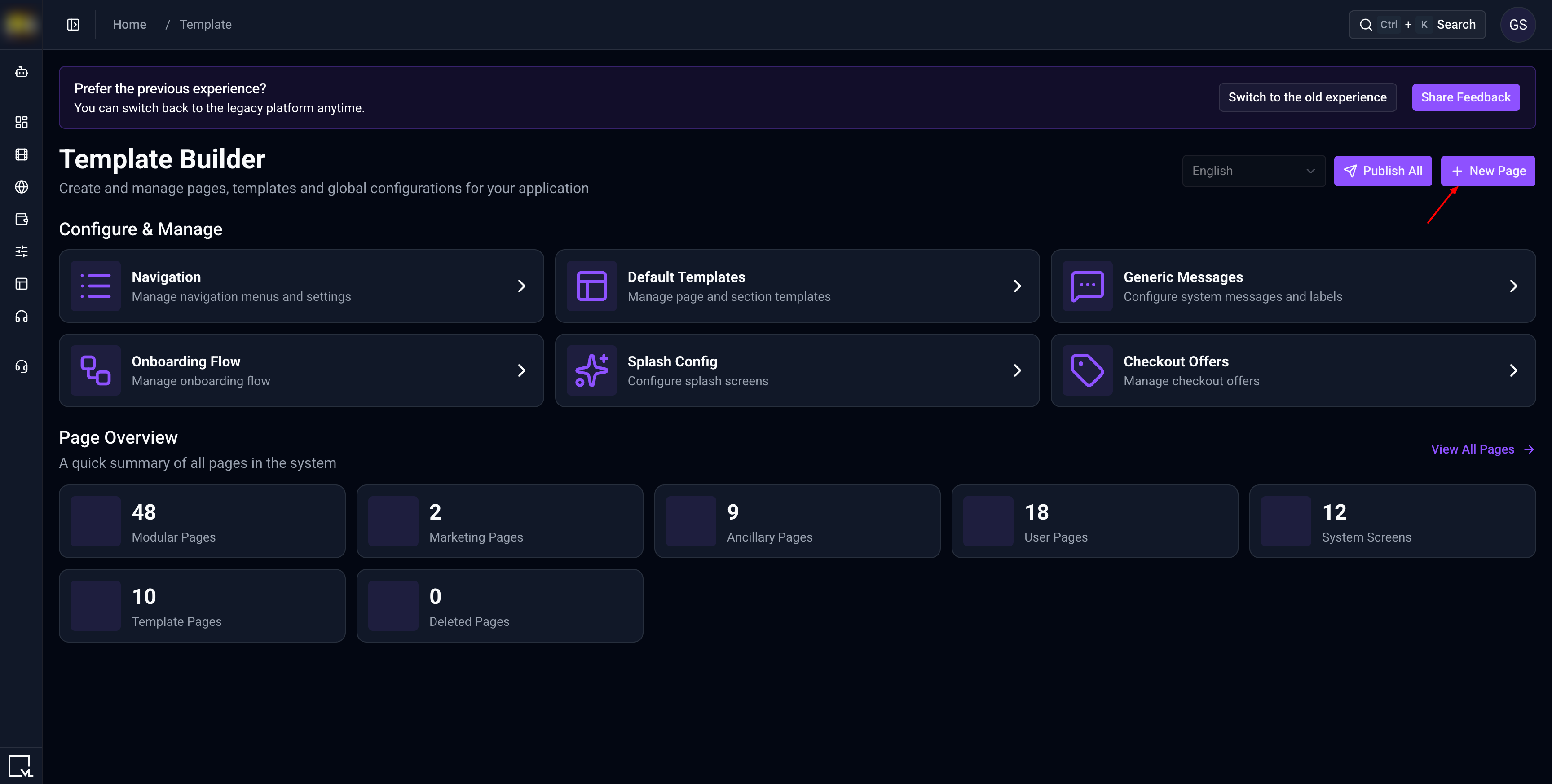
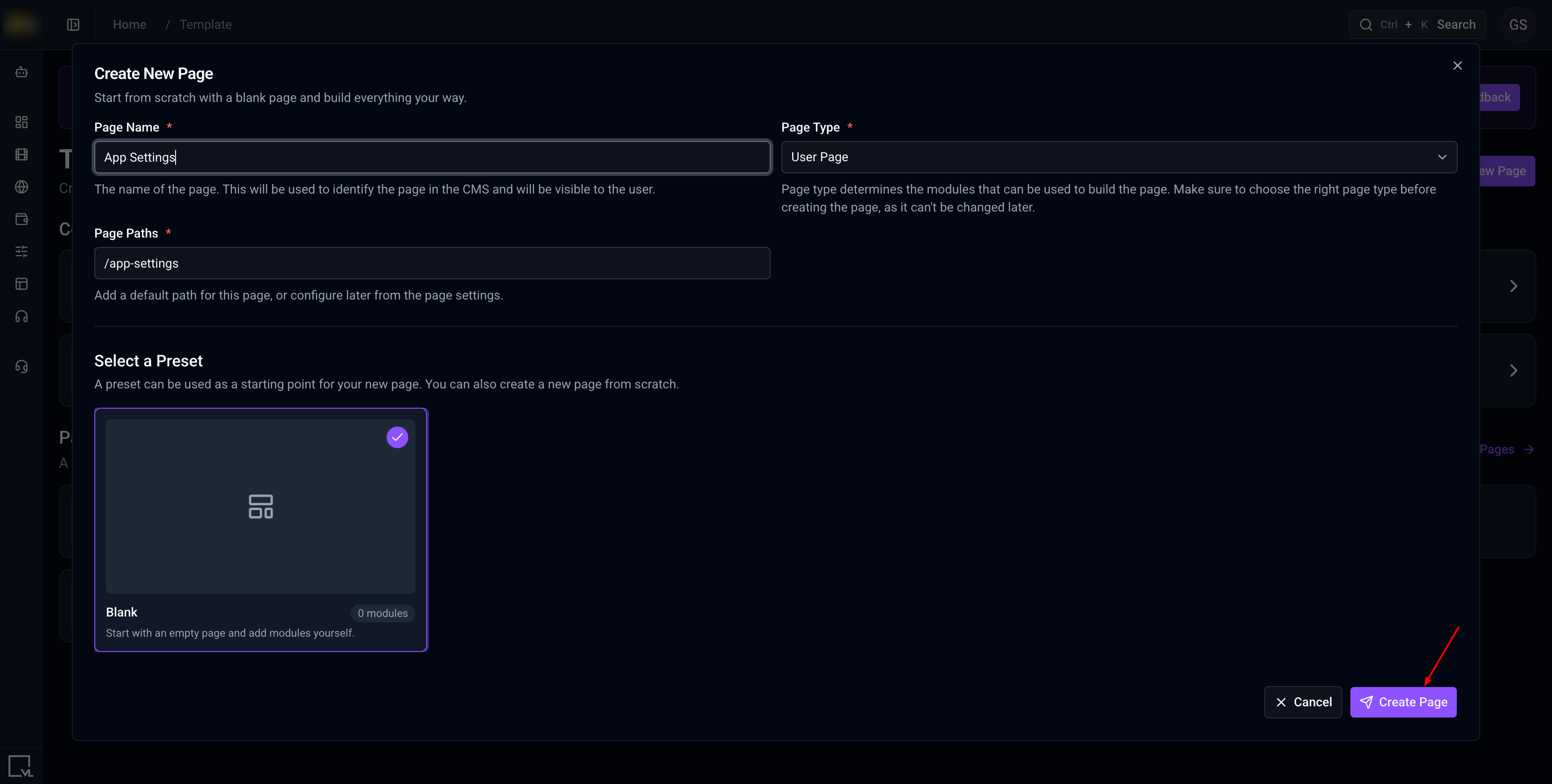
Create New Page with User Page selected as the Page Type. Start from + New Page on the Template Builder home screen, or from New Page on View All Pages.
Also available on: Modular Page, Marketing Page, and System Screen. For the standard account-settings experience, use a User Page.
Step 2: Add the VL App Settings module
- Open the new page in the Template Builder editor.
- Select Add Modules.
- Open the User group, or search for
VL App Settings. - Select VL App Settings to add it to the page.
- Select the module on the page to open its settings.
If the module does not appear in the list, clear the platform filter or select an app platform. VL App Settings is hidden when the editor is filtered to Web only.
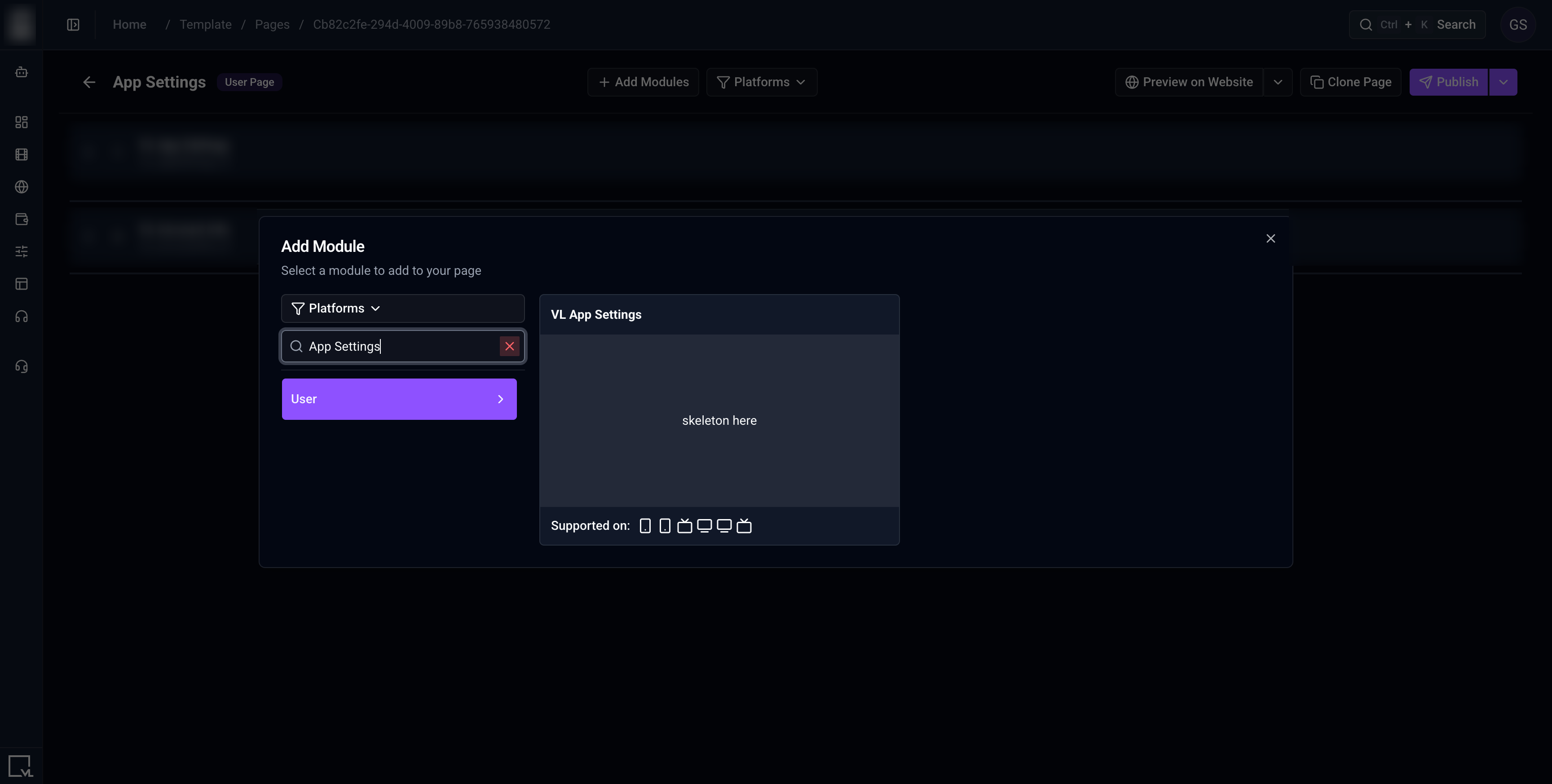
Add Modules → User. Search for and insert VL App Settings.
Step 3: Configure Content labels
Open Content and review these localizable labels:
| Setting | Description | Default |
|---|---|---|
| Title | Heading for the App Settings screen. | App Settings |
| Auto Play Label | Label for the auto play setting. | Auto Play |
| Closed Captions Label | Label for the closed captions setting. | Close Captions |
Use short, customer-facing labels. If your site supports multiple languages, review these values in every published language.
This module has no Layout color or permalink fields. The three labels above are the settings you configure for VL App Settings.
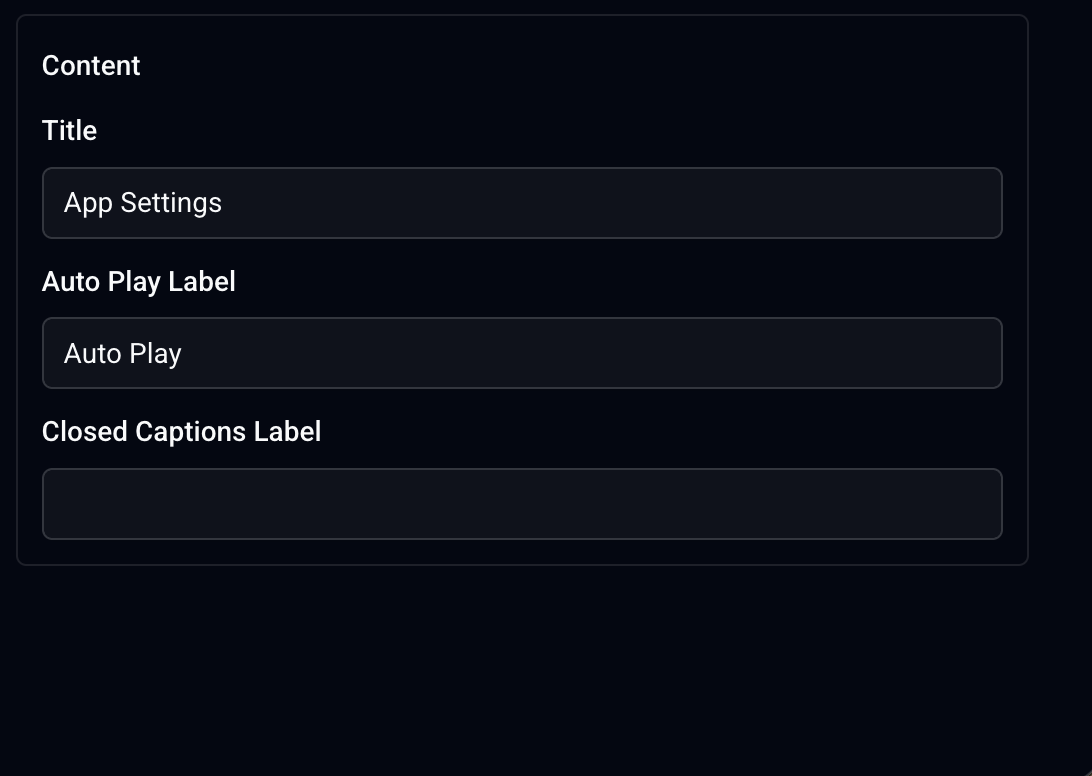
VL App Settings → Content. Edit Title, Auto Play Label, and Closed Captions Label.
Step 4: Review delivery settings
The inspector can also show these common settings:
| Setting | Description | Default |
|---|---|---|
| Platforms | Limits where this instance of the module is delivered. Do not select Web only. | No explicit restriction |
| Enable Personalization | Appears only when personalization is enabled for the site. | Off |
VL App Settings is not enabled for the website. Leave Enable Personalization off unless your site’s personalization setup requires this module to participate.
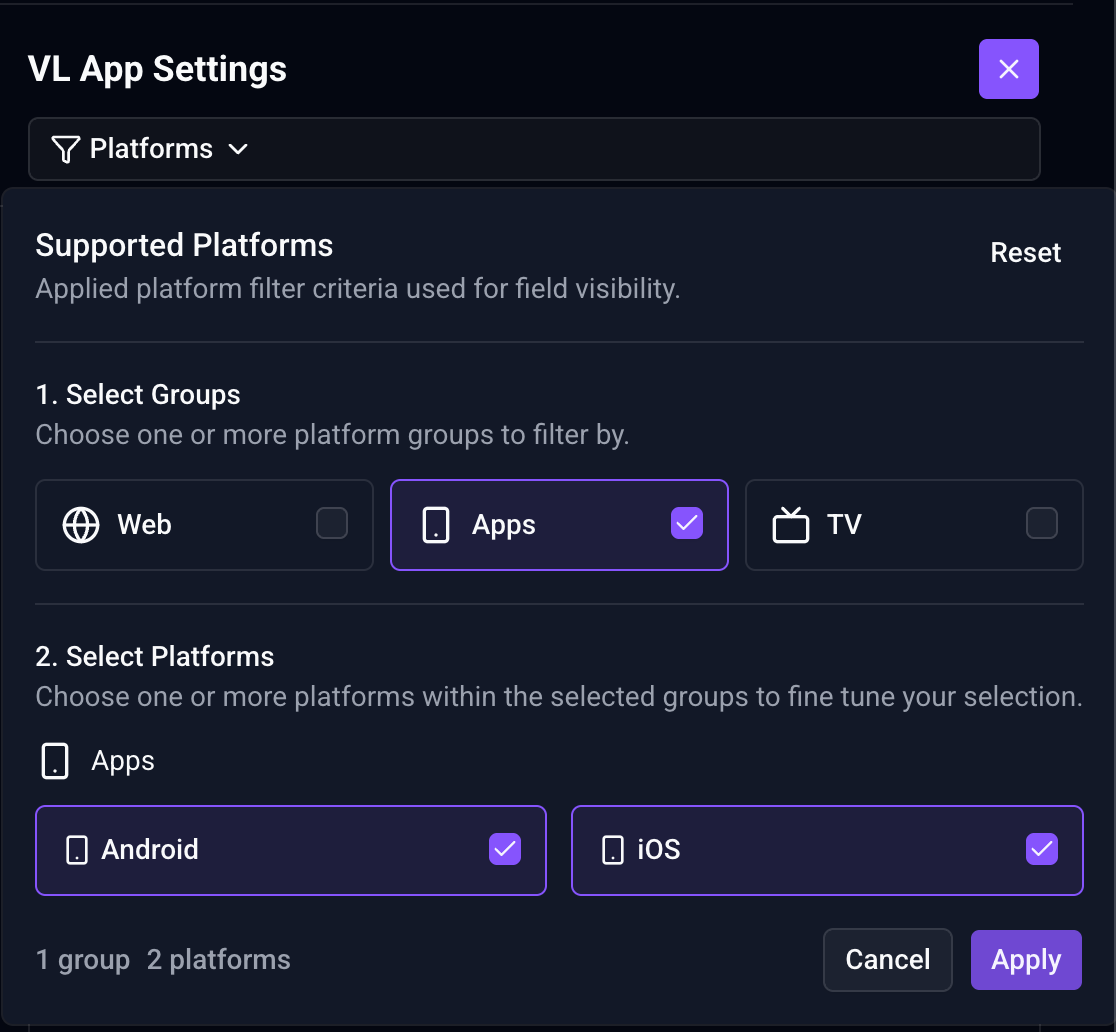
Supported Platforms with an app platform selected while configuring VL App Settings.
Step 5: Publish the page
- Review the page layout and module settings.
- Select Publish in the page toolbar.
- In the confirmation dialog, select Publish Page.
- Wait for the publish action to complete.
Until the page is published, apps will not show your latest App Settings labels.
Step 6: How it looks in an app
Open App Settings in a supported app after you publish the page.
Customers typically see:
- Title — from Title (for example App Settings)
- Auto Play — from Auto Play Label
- Closed captions — from Closed Captions Label
The exact layout, toggles, and additional rows (for example app version) depend on the app. Confirm the published labels on your target apps rather than on the website.
This module does not render on the website. A web URL for /app-settings is not the verification path.
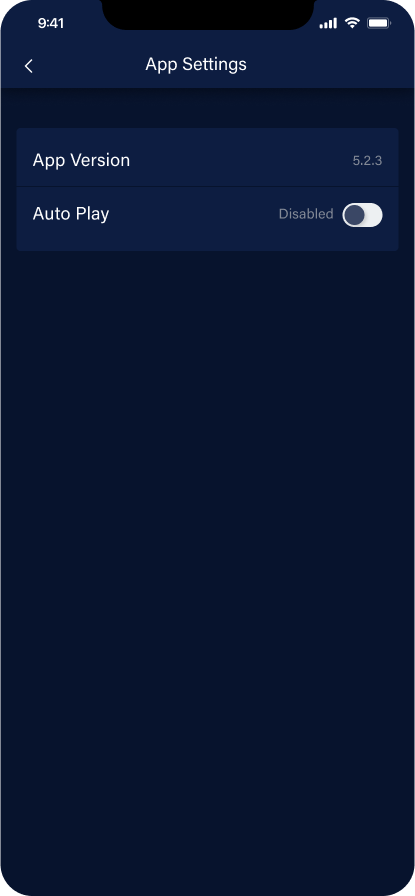
App Settings screen on a supported app, showing the title, auto play label, and closed captions label.
Verification checklist
- Page exists as a User Page
- Page path is
/app-settings(or the path your apps use) - VL App Settings is on the layout
- Title, Auto Play Label, and Closed Captions Label are reviewed for launch language(s)
- Platform filter is not limited to Web while editing
- Page is published
- A supported app shows the expected title and setting labels
- The website is not used as the verification surface for this module
Troubleshooting
| Problem | What to check |
|---|---|
| VL App Settings is not in the module list | Confirm the page type is User Page (or Modular Page, Marketing Page, or System Screen). Clear a Web-only platform filter. |
| Labels do not change in the app | Save the module settings, publish the page, and allow cache to clear. For localization, edit labels in the correct language. |
| Nothing appears on the website | Expected. This module is not enabled for web. Verify in a supported app. |
| Auto play or captions behave unexpectedly | This module sets labels only. Playback behavior is controlled in the app. |
| Extra rows appear on the app (for example version) | Those come from the app, not from this module’s three Content fields. |
| Changes do not appear immediately | Confirm the page is published, then relaunch or refresh the app after allowing time for cache updates. |
Best Practices
- Use one User Page at a stable path (for example
/app-settings). - Keep labels short and consistent with the rest of the app.
- Localize Title, Auto Play Label, and Closed Captions Label when the site has more than one live language.
- Do not rely on website preview for this module.
- Test at least one supported mobile or TV app before launch.
- Publish after every label change.
FAQs
Q. What page type should I use for VL App Settings?
User Page. The module is also available on Modular Page, Marketing Page, and System Screen.
Q. How do I create the page?
Select + New Page on the Template Builder home screen, or open View All Pages and select New Page. Then choose User Page, enter the name and path, and select Create Page.
Q. Does this module work on the website?
No. It is not enabled for web. Verify it in a supported app.
Q. Which labels can I edit in this module?
Title, Auto Play Label, and Closed Captions Label.
Q. Why does the Closed Captions Label default say Close Captions?
That is the default label in Template Builder. Change it if your app should say Closed Captions or another phrase.
Q. Are there Layout settings?
No. VL App Settings has no background, color, or permalink fields.
Q. Will changes appear immediately in the app?
Often within several minutes after publish. Relaunch the app if you need to verify sooner.
Important Information
- VL App Settings belongs on a User Page.
- The module is not enabled for the website.
- Configure Title, Auto Play Label, and Closed Captions Label only.
- The Closed Captions Label default is
Close Captions. - Verify published labels in a supported app, not on the website.
- Auto play and caption behavior are controlled by the app, not by this module’s form.
Glossary
| Term | Definition |
|---|---|
| User Page | Template Builder page type used for account and profile screens. |
| VL App Settings | The Template Builder module documented in this article. |
| Auto Play | In-app setting that can continue playback without a new customer action. |
| Closed captions | On-screen text that accompanies audio in the app. |
| Platform filter | Template Builder control that shows modules and fields for selected platforms. |
Contact Support
If you need help beyond this article, contact the ViewLift support team.
- Email: techsupport@viewlift.com
- Phone (US): +1-800-859-0420
- Phone (UK): +44-203-014-8921
Support hours: B2C requests are handled Monday to Friday. B2B support is available 24/7.