Integration
Recommended integration model: caller owns preset orchestration; UI shells stay presentational.
Recommended Pattern
Use this split in module implementations:
- Caller module owns
useSaveAsPreset() - Import UX uses a file input trigger controlled by the caller module
- Caller invokes
importPreset({ inputRef, expectedResource })from the CTA - Caller validates imported payload against module schema before
form.reset() - Export dialog (if enabled) remains presentational and callback-driven
This keeps transport parsing reusable and keeps domain hydration ownership in the module.
Example Flow (Import -> Parse -> Hydrate)
ExampleWorkflowModule can wire import flow directly from its CTA.
Download/export capability still exists in useSaveAsPreset and can be enabled separately when needed.
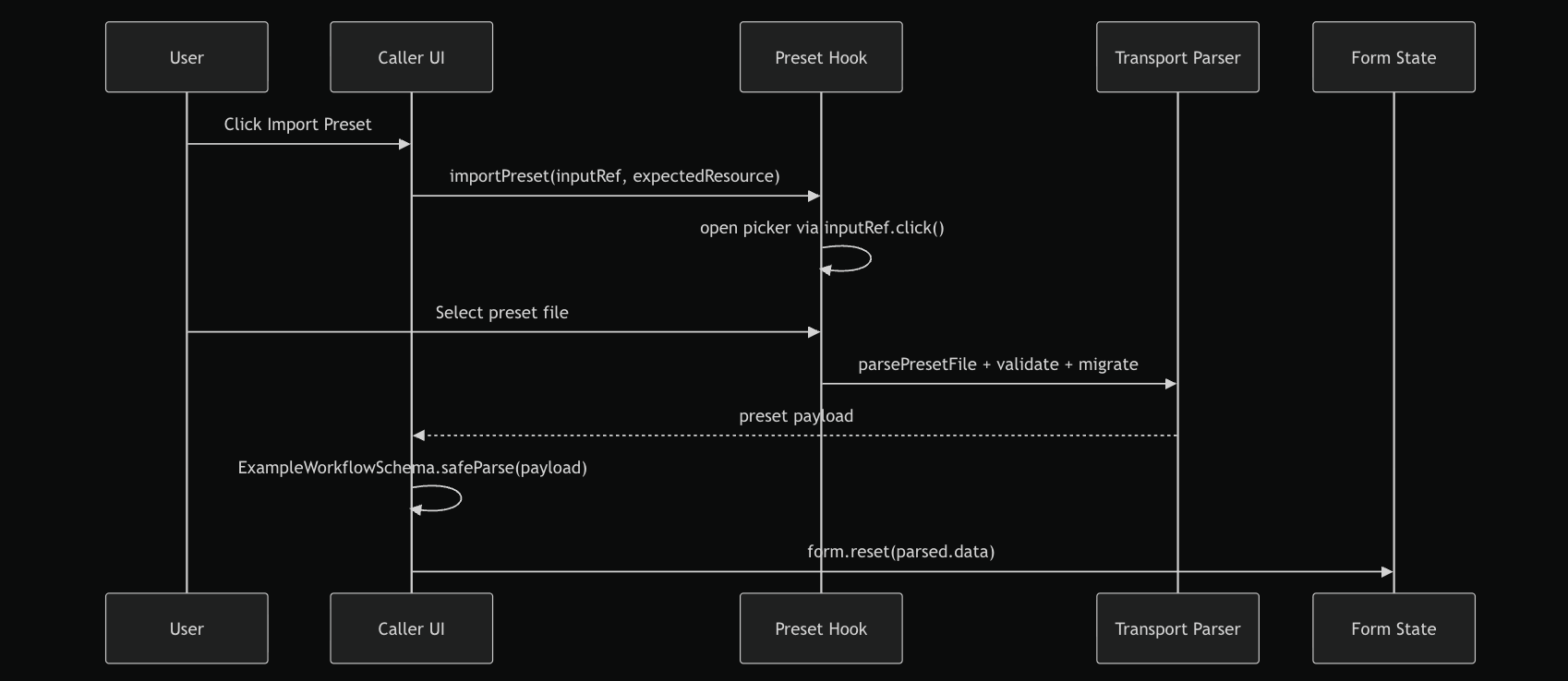
Integration Example (Caller-owned Hook)
const { importPreset } = useSaveAsPreset();
const importInputRef = useRef<HTMLInputElement>(null);

async function handlePresetImportClick() {
  const imported = await importPreset({
    inputRef: importInputRef,
    expectedResource: 'example.workflow',
  });

  if (!imported) return;

  // Transport parse succeeded. Domain schema validation remains caller-owned.
  const parsed = ExampleWorkflowSchema.safeParse(imported.preset.payload);
  if (!parsed.success) return;

  form.reset(parsed.data);
}

return <input ref={importInputRef} type="file" className="hidden" accept="application/json,.json" />;
Optional Export Dialog Contract
If a module enables download/export UX, dialog components should only manage local UI input state and emit callbacks.
type SaveAsPresetDialogProps = {
  open: boolean;
  onOpenChange: (open: boolean) => void;
  config: {
    resource?: string;
    workflowName?: string;
    fileName?: string;
  };
  onDownload: (presetName: string) => void | Promise<void>;
};
The dialog should not import or call useSaveAsPreset() directly; caller modules remain the orchestration boundary.
Import Boundary Checklist
When consuming imported presets:
- Parse transport via
importPreset(...) - Validate
resourcecompatibility viaexpectedResource - Validate
preset.payloadvia module schema - Call
form.reset(...)only when schema parse succeeds
This keeps transport concerns and domain concerns cleanly separated.
Error Handling Guidance
Always surface deterministic messages returned by useSaveAsPreset() (internally mapped via getPresetUserMessage).
For module schema failures (after transport success), emit module-specific validation guidance instead of transport errors.