Context
OneCMS requires a global command center to enable fast navigation, action execution, and discovery across modules and deep-linked sections.
Initial implementation introduced fuzzy search (Fuse.js), route-based indexing, and a command palette UI. As the system evolved, multiple concerns emerged:
- heterogeneous data sources (routes, settings, content, actions)
- need for consistent search behavior across domains
- separation between discovery (search) and execution (actions/navigation)
- requirement for extensibility without coupling UI, data, and execution logic
A clear architectural model was required to prevent tight coupling and ensure scalability.
Decision
The Command Center is implemented as a layered, adapter-driven system with strict separation of concerns.
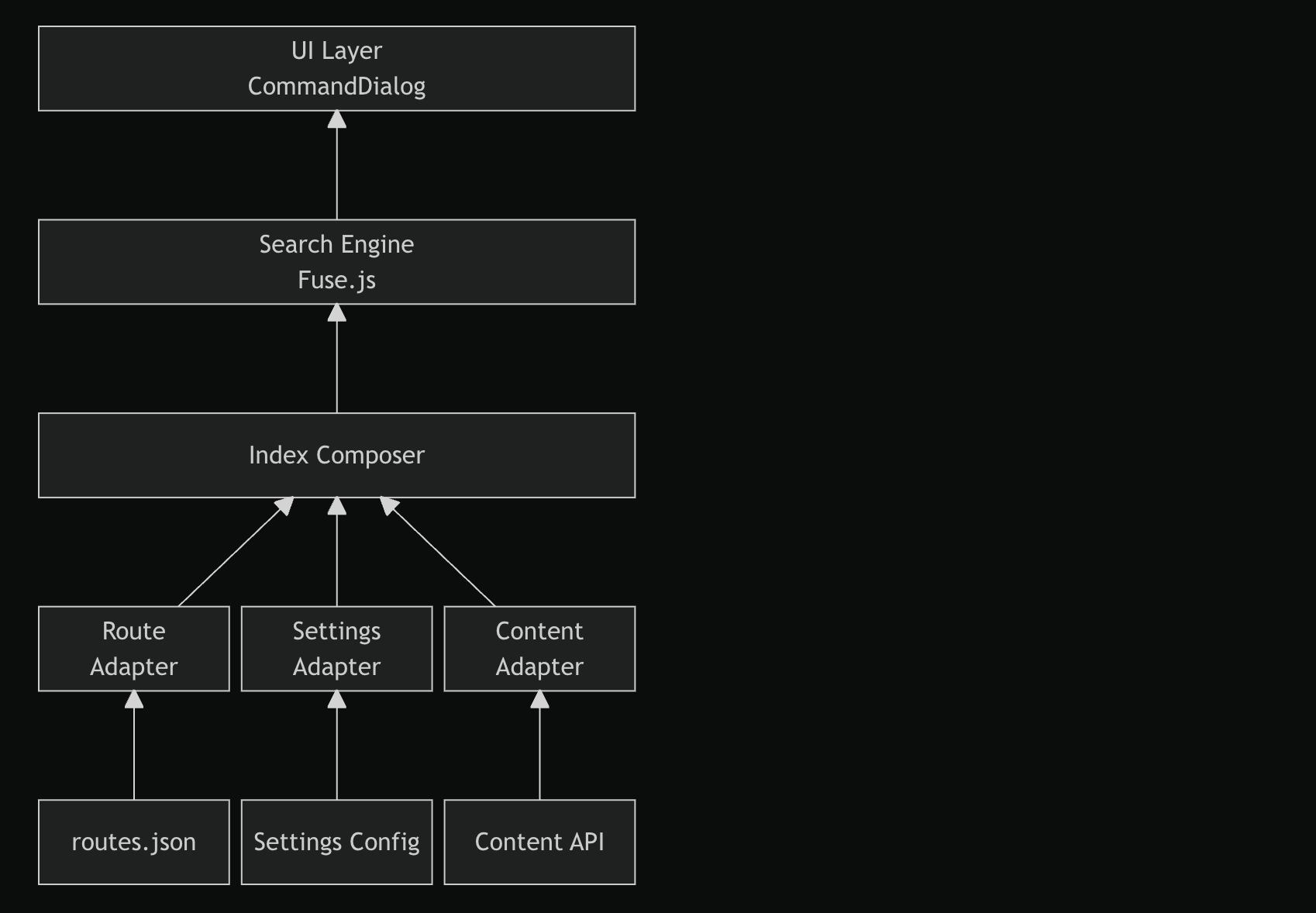
- All searchable data is normalized into a unified
IndexItemstructure. This is the only data shape consumed by the search system. - Each domain (routes, settings, content, actions) must provide a normaliser adapter that converts raw domain data into
IndexItem[]. Adapters are pure and do not contain execution or UI logic. - Index composition is handled via a registry-based system where all adapters are registered and invoked to produce a unified index.
- Fuzzy search (Fuse.js) is used strictly as a scoring mechanism over the unified index and does not contain domain-specific logic.
- Search results are transformed into a UI-facing
CommandResultstructure via a dedicated adapter layer, isolating library-specific output from the rest of the system.

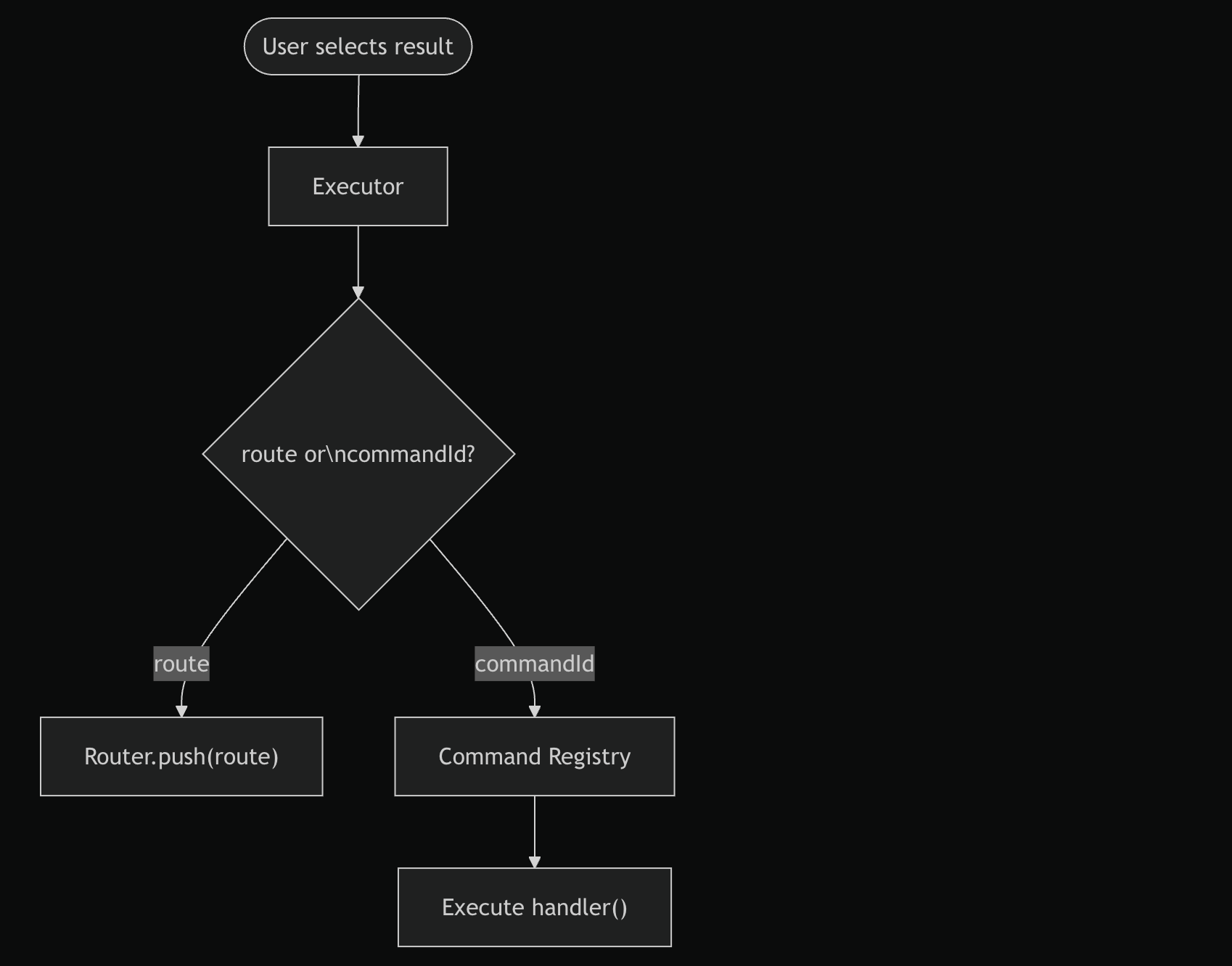
- Execution is decoupled from search:
- navigation is driven by
route - actions are driven by
commandId
Execution logic is handled by a command registry and executor layer.
- navigation is driven by
- The UI layer acts as a pure consumer of
CommandResult[]and delegates all execution to the executor. It does not perform search, transformation, or business logic.
Consequences
- Enables consistent search and command behavior across all domains
- Allows new data sources to be added via adapters without modifying core logic
- Decouples search, data normalization, and execution for maintainability
- Makes Fuse.js replaceable without affecting UI or adapters
- Introduces additional layers (adapters, registry, executor) that require discipline
- Requires all domains to conform to the IndexItem contract
- Shifts responsibility for search quality to adapter implementations
:::info Value Added
- Adds a unified, fast interaction layer that lets users navigate, find, and act across the entire platform instantly from a single entry point.
- Reduces friction and cognitive load by eliminating the need to remember locations or traverse nested UI structures.
:::
Notes
- IndexItem is the canonical language of the command system
- Adapters are first-class architectural components, not utilities
- Deep navigation (e.g., nested settings) is handled via enriched indexing, not separate types