Context
The platform requires a controlled way to enable, disable, and gradually roll out features across environments, users, and organizations without relying on redeployments.
Previous approaches risked:
- UI-driven toggles leaking into business logic
- Remote feature flag tools becoming the source of truth
- Flags accumulating indefinitely with unclear ownership
- Feature flag infrastructure becoming a hard dependency that could break the app if misconfigured
Additionally, the backend team was not positioned to own or expose feature-flag evaluation APIs, requiring a frontend/server-side owned solution that remained safe, testable, and portable.
A clear architectural boundary was needed to ensure:
- Code remains the authority over what features can exist
- Remote tools remain advisory, not authoritative
- Feature flags cannot compromise application stability or security
Decision
The platform will implement a code-owned feature flag system with the following properties:
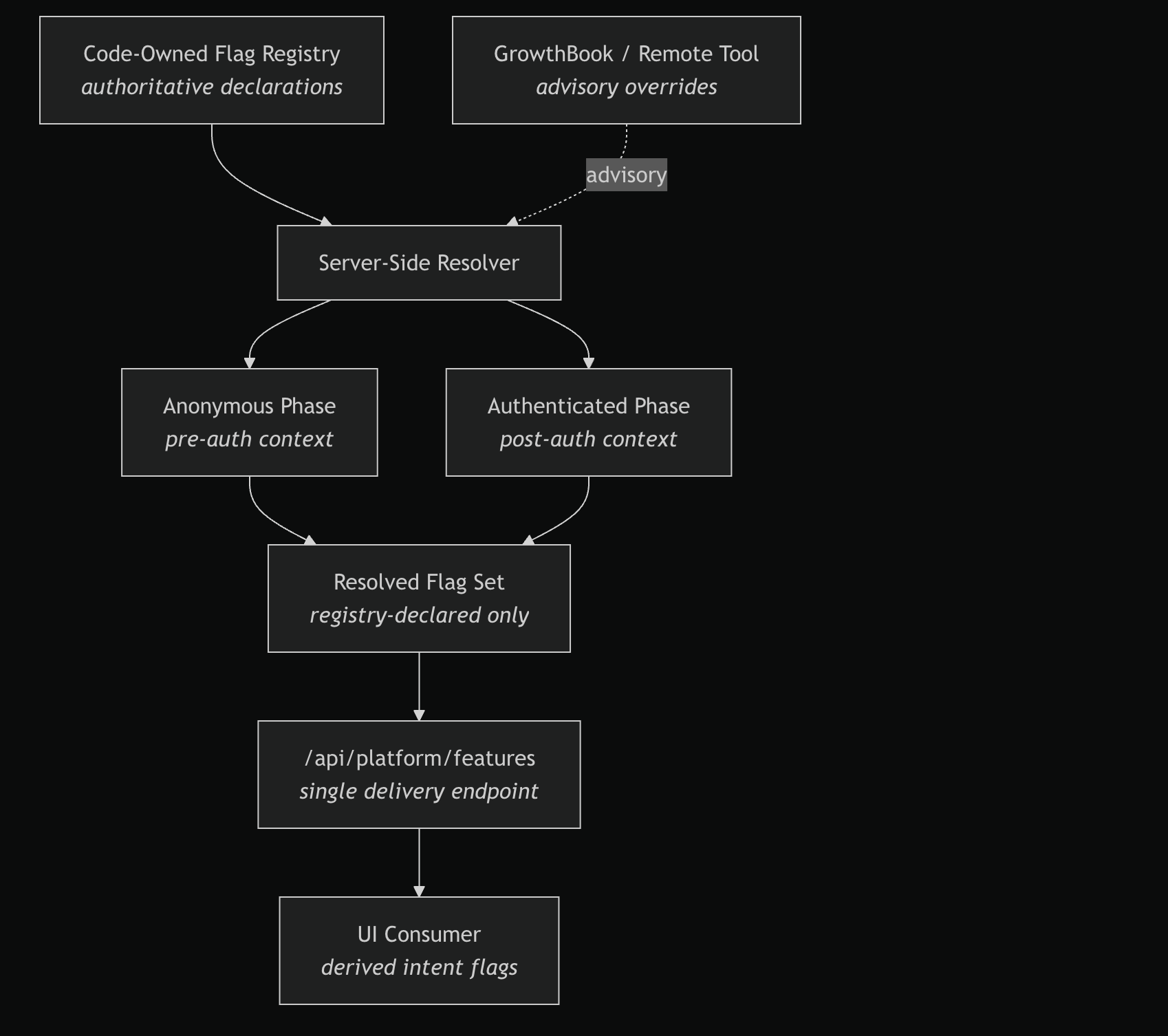
- All feature flags must be declared in a central registry in code
- Remote feature flag tools (e.g. GrowthBook) are advisory only
- Only registry-declared flags are evaluated; all others are ignored
- Feature flags are resolved server-side
- UI consumes derived, intent-based flags, never raw infrastructure flags
- Feature flag infrastructure is optional and must fail safely
- Anonymous and authenticated users use the same resolver with different available context
- A Next.js server API (
/api/platform/features) is the single delivery point for UI-facing flags. - For this endpoint to work correctly, there needs to be
NEXT_PUBLIC_PLATFORM_BASE_URLadded in the main environment variables.
The system is designed as a portable engine, independent of Next.js, GrowthBook, or OneCMS-specific concepts.
Consequences
Enables
- Safe feature rollouts without redeployments
- Deterministic behavior with explicit defaults
- Easy deletion of obsolete feature flags
- Frontend-owned delivery without backend dependency
- Portability of the feature flag engine to other projects
- Clear separation between infrastructure concerns and UI behavior
Restricts
- Feature flags cannot be created or consumed ad-hoc
- All new flags require a code change (registry update)
- UI cannot directly access or reason about infrastructure-level flags
- Feature flags cannot be used for authorization or data integrity enforcement
Trade-offs
- Slightly more upfront discipline when adding flags
- Remote tools may accumulate unused flags without impact
- Feature flag evaluation occurs per request rather than globally cached
These trade-offs were accepted to prioritize safety, clarity, and long-term maintainability.
Notes
-
Feature flags are resolved in two phases depending on context availability:
- Anonymous (pre-auth)
- Authenticated (post-auth)
-
Cookies are used as a read-only source of derived context after middleware validation
-
GrowthBook misconfiguration or outage results in safe fallback to defaults
-
Deleting a flag from the registry immediately removes it from the platform, regardless of remote state
-
This architecture intentionally mirrors other platform patterns (e.g. UploadEngine, Notification intent → side-effects)